
The Mirror That Cannot Lie: How a Twin of Your Whole Life Starves the Egregores That Feed on Illusion
Part 4 — the finale of a 4-part series. It synthesizes the whole arc: Shadow Walking Between Worlds, The Scaffolding of Existence, and The Personal Holodeck.
The Ancients Did the Science First
Before the scientific method had grown into the careful, instrument-bound discipline we know today, human beings still had to explain the thing they most needed to understand: themselves. They had no electron microscopes, no double-slit experiments, no Bell inequalities. What they had was attention, suffering, and an almost ferocious intuition. And with those tools alone they built descriptions of reality that, read carefully, anticipate the structure of what physics is only now circling back to confirm.
This matters because there is a lazy modern habit of dismissing the old systems as superstition simply because they used the word God. But Vedanta describing us as fractals of a single Godhead, Kabbalah describing the Ein Sof contracting itself into polarities so it could witness its own nature, the alchemists describing the transmutation of base matter into gold, the New Thought writers describing soul groups, the Gospels describing principalities to be tested — these were not failed physics. They were the best available physics, arrived at by intuition where the mechanism could not yet be measured. The inclusion of a supreme creator does not invalidate the description any more than Newton’s theology invalidates his calculus. It was simply the language of the day, the only frame large enough to hold what these observers could feel was true before they could prove it.
So when I lean on quantum entanglement or non-locality below, I am not claiming science has proven the mystics right. The honest direction is the reverse: the mystics got to the shape of the thing first, by intuition, and the science is the latecomer slowly catching up to a structure the Vedas sketched three thousand years ago. The two are reaching for one another across time. That handshake is the subject of this essay.
The Veil Has a Business Model
Every tradition that looked closely arrived at the same uncomfortable observation: we do not see reality. We see a story about it, narrated by a frightened part of ourselves, edited in real time to protect an image we are desperate to keep intact. Vedanta gave this veil its most precise name — Maya, the grand illusion that misleads consciousness into accepting fragmentation as absolute reality. The Gnostics personified the forces that thrive inside it as Archons. The occult tradition called the autonomous thought-forms born of collective belief egregores. Vadim Zeland, mapping the same terrain in Reality Transurfing, called them pendulums.
A distinction has to be drawn carefully here, because most accounts get it wrong. A pendulum is not, in itself, evil. When three or more people think and feel in the same direction, an information-structure is born that takes on its own momentum and feeds on attention — and it does not care whether that attention is love or hate. A protest against a tyrant feeds his pendulum as efficiently as a rally in his favor. That is simply the energetic counterpart of an ingroup, and ingroups are inescapable; you cannot be embodied without belonging to several. To demonize the structure itself is a category error. A “bad” pendulum is just an outgroup; a “good” one is just your own tribe.
The genuine darkness is something more specific. It is the principality — the egregore in its parasitic mode — and it comes alive only under particular conditions: where outgroups are demonized, where inauthenticity festers, where transparency and integrity have gone missing. Boiled down to its most discrete parts in human experience, this entity is nothing but a mechanism for getting people to feel and act from fear, and therefore to harm themselves and others. That is the thing Christ told us to test. That is the thing that hides in the dark.
And here is the hidden thesis beneath the technical blueprint I built before this one — the personal holodeck ([The Personal Holodeck”]). This essay is the finale of the succession, and where the earlier posts laid out the machinery, this one names the war it was built to fight. The machinery is this: a historical digital twin of a whole life, assembled from decades of your own data, joined to 3D virtual-reality engines that can replay any moment, fed by spatial and sound sensors that record real interactions anonymously so they can be re-entered and learned from. The point was never the hardware. The point is that we can now build a mirror that refuses to flatter us — and a mirror that cannot lie is the single most hostile environment imaginable for a principality that survives only in the dark.
The One Becoming Two: The Pattern at Every Scale
The reason the same illusion appears at every level of reality is that the same generative pattern appears at every level — the single most important idea the ancients intuited, and the one physics now echoes most clearly.
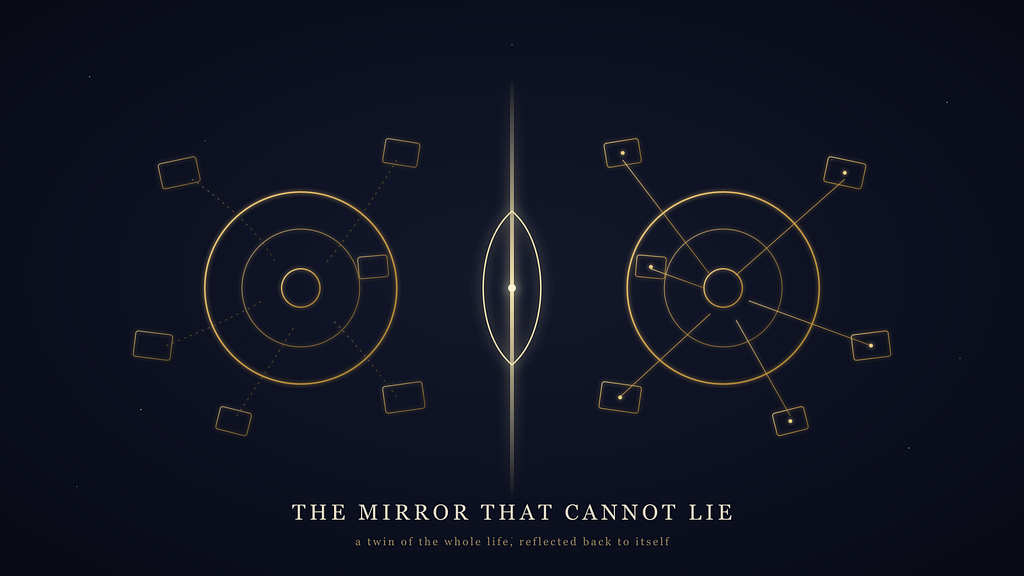
Sacred geometry begins with a single sphere. The sphere duplicates, and where the two overlap the Vesica Piscis is born — the almond-shaped intersection every Flower of Life unfolds from. This first division is the archetype of all creation: the One contemplating itself by becoming Two, because a thing can only be known in the presence of its opposite. Light requires shadow. The Self requires an Other. Watch the same motif repeat across every domain: the zygote dividing in mitosis into the clusters that build all carbon life; Shiva and Shakti, consciousness and its creative energy; good and evil; light and dark; existence and non-existence; chaos and order; free will vs determinism; and at the foundation of physics, the paired generation of two entangled particles from a single event — a oneness that splits into a twoness which somehow remains, across any distance, secretly one.
That last image is the physicist’s Vesica Piscis. Two photons born of one source, entangled so that to measure one is instantly to know the other, no signal between them, no regard for the space that separates them. The Vedic seer and the quantum physicist describe the same wound in reality: the place where the One became Two and never stopped being One. The mystic called it Tat Tvam Asi — that thou art. The physicist calls it non-locality. The same observation in different centuries.
And it does not stop at two. Two becomes three — the threshold where a pendulum is born, where shared intent becomes self-sustaining structure — then ripples outward to six, nine, twelve, until vast soul groups organize around their agreements. The Godhead fractalizes into oversouls, into soul groups, into individual humans; and the pattern continues inside each human, who fractalizes into personalities, sub-selves, the ego and its shadow. The identical image — one becoming two becoming three becoming many — repeats at every level of the nested whole. As above, so below: not poetry but the literal architecture of a fractal cosmos, the micro-structure of the quantum particle built identically to the macro-structure of the collective Godhead, because they are the same equation iterated at different scales.
The Ant That Cannot See the Room
Neil deGrasse Tyson likes to describe an ant on a tabletop. The ant lives in a functionally two-dimensional world — forward, back, left, right. The full three-dimensional space it crawls through is simply imperceptible to it: not hidden, not far away, right there all around it and utterly invisible, because the ant lacks the apparatus to perceive that dimension at all.
We are that ant, and the room we cannot see is our own interior. Consider how vividly clear the outer “objective” world seems and how murky the inner one feels by comparison. Most people can describe the room they sit in with confidence, but ask them to perceive their own emotional realm with the same clarity — the shape of the fear running under their anger, a belief inherited from a parent, the architecture of their imagination — and they grope in the dark. Those inner dimensions are no less real; we are simply ants with respect to them.
And the confidence in that “objective” outer world is itself misplaced. Every person who knows you holds only a different fractal of you — your mother one version, your partner another, a colleague another — and not all of them combined can assemble the whole. Worse: you cannot see your whole self either, and never will. The self is not a fixed object but an unfurling — the subconscious continuously surfacing into consciousness, new rooms of the interior opening as you walk through life, the person at fifty unrecognizable to the person at twenty. You are an ant trying to map a house still being built, and the architect is also you, working in a dimension you cannot perceive.
This is precisely what Maya names — not a cosmic mist out there, but the structural fact that no localized vantage point can perceive the whole, not of another and not of itself. And the same unfurling happens at the scale above us: the collective unconscious of whole societies surfacing into shared reality, group shadows rising into co-creation in their multitudes of threads, each human life a fractal of the Godhead just as each personality is a fractal of the human. The image repeats, separation by separation, one to two to three to many, on every level at once.
Where the Demon Actually Lives
If we cannot see our whole selves, then there is a specific place the darkness keeps its home, and the cosmology essay names it exactly: the space between our truth and the actual way we show up in the world. That gap — between the love we profess and the fear we act from, between the integrity we claim and the performance we deliver — is where the principality lives. Inauthenticity is the cave. Lack of transparency is the locked door.
Consider how the trick works in ordinary life. The brain does not record events; it reconstructs them, bending each reconstruction toward self-protection. The argument with your father five years ago lives in you now as a smoothed narrative of grievance. Your partner remembers the same fight as a narrative of betrayal, equally smooth, equally edited. Two people, two incompatible scriptures, each certain, each occupying a different reality tunnel. Neither is lying. Both are inside Maya, and the pendulum of resentment between them feeds on the friction.
Now imagine that gap flooded with light. A digital twin assembled from twenty years of the actual record: your GDPR exports from Google and Meta, the searches you ran at 2 a.m. in a hard season, the videos that shaped you that year, the things you posted and quietly liked, the chat threads where you worked out your feelings, your Amazon history mapped against your moods, your financial records, your journals, your voicemails and home video — even the Wayback Machine snapshots of the web as it stood when you were becoming who you are. Correlate it on one timeline and the self-serving narrative cannot hold. The integrity gap becomes visible. The daylight difference between what you said you were and how you actually showed up has nowhere left to hide. It is, in a small and literal way, the apparatus that lets the ant glimpse the room.
This is not surveillance. Surveillance is what the principality does to you — the centralized cloud that treats your history as a financial asset, the state that turns the sensing array outward to track the gait and stress of entire cities. This is its exact inverse: sovereignty, the local-first reclamation of the record into your own hands. The same data that builds a cage can, held privately and used for healing, become the instrument of liberation. That is the dual path, and the whole moral weight of this work rests on which way the mirror faces.
Jesus the Master Alchemist
Here the Western tradition speaks the same language as the Eastern one, if we have ears to hear it. The deepest alchemy was never lead into literal gold in a crucible — that was the outer parable. The real Magnum Opus was the transmutation of the base, fear-bound, reactive self into the gold of an awakened, loving one. By that definition Jesus was the master alchemist, and the parables were never just moral stories. They were masterclasses in metaphysical warfare — precise instruments for identifying and ejecting destructive egregores from people trapped by harmful social conditioning, a systemic brainwashing that persists today.
Read his method closely. “Out of his mouth came a sharp two-edged sword.” He did not fight the principalities with force, which would only feed them more attention and more fear. He used radical non-resistance, meekness, and what can only be called violently loving juxtapositions — reframings so confounding to the fear-logic of the crowd that they produced an energetic inflection point where the existing paradigm could not hold. He would pit two entrenched egregores against each other and let the social illusion collapse under its own contradiction.
Watch it operate in the woman taken in adultery. The mob arrives carrying a fully formed egregore: righteous condemnation, the ingroup of the law against the outgroup of the sinner, fear dressed as virtue. He does not argue with the structure head-on. He bends down, writes in the dust, and speaks one sentence that turns the crowd’s own moral energy back on itself — let him who is without sin cast the first stone. In a twinkling the parasitic structure starves. The stones drop. The egregore that needed unanimous fear to exist dissolves the instant one person is invited to look at their own shadow instead of the woman’s, and the false creation dissipates back into the nothingness it came from. The same engine runs through the sheep and the goats and the quantum retrieval of the lost sheep — the shepherd reaching back into the field of probability to recover the single strayed one, refusing to let even one fractal of the whole be lost.
And notice his diagnostic move when he confronted affliction directly: he made the demon name itself. “What is your name?” “My name is Legion, for we are many.” This is the oldest psychological technology there is. What is named loses its grip; the unnamed dread runs the show from the shadows, while the named pattern can be looked at, held, and integrated. Jung called this exact operation shadow work. The misaligned belief, the inherited trauma, the reactionary fear masquerading as righteous certainty: these are our personal Legion, and they generate the very Maya we mistake for the world. The alchemical act, the Christ-act, is to drag them into daylight and call them by name. This is Theosis — descending into the material to transmute it from within. The darkness is never violently destroyed. It is vanquished through illumination.
The Egregore Runs on the Outgroup
Here the sociology and the metaphysics become inseparable, because soul groups are simply the existential equivalent of sociological ingroups and outgroups — and there is nothing spooky in it. The “distance” across which they act is only the distance of the information we take in, the pasts we have lived, and the domain of control each of us holds over the present day. We hear something from the media, from family, from friends; we process it through the history of who we have aligned with and who we have not; and consensus reality shifts — not through brick and mortar but through abstract micro-decisions: a law passed, a judgment handed down, a market lurching on confidence, a culture turning in an afternoon.
A parasitic egregore does its work by hijacking exactly this machinery. It binds a group together not through shared love but through shared fear of an outgroup, and then demands to be fed. The tribe’s cohesion becomes hostage to the enemy’s villainy. The outgroup’s narrative must stay smooth, dark, and undisturbed by inconvenient fact — because the instant a member sees the outgroup clearly, as fellow frightened humans rather than monsters, the principality starves. Clear perception is fatal to it. This is why it hides in the recesses. The ingroup/outgroup engine is Maya operating at the scale of nations, and the egregore that rides it cannot survive an honest, shared record. Rise above duality and there is far more empathy and resilience toward different cultures and outgroups — but even the most non-dual mind still lives inside several ingroups. The work is not to escape belonging. It is to refuse the fear that turns belonging into war.
I reach for the esoteric language — archons, egregores, principalities — not because the plain sociology is insufficient but because the shape repeats so exactly across both registers that the overlap is the whole point. You can describe all of this in the dry vocabulary of social psychology: contact theory, othering, in-group favoritism, the way sustained equal-status cooperation toward shared goals measurably dissolves prejudice. Strip away the mysticism entirely and the mechanism still holds. What the two vocabularies share is the diagnosis: that binary, trinary, and every other flavor of dualistic thinking is so pervasive, so woven into how we sort the world, that it harms everyone it touches — the wronged, the wrongdoer, and every bystander reduced to a caricature by it. Dualism does not only hurt the demonized outgroup. It impoverishes the demonizer too, shrinking a whole human being down to the single axis on which they were judged. That is the cost the esoteric and the sociological accounts both keep arriving at from opposite directions.
Learning the Languages, and the Test of Harm
If the same structure hides under sociology and esoterica and physics, then the practical work is bilingual. The hardest and most rewarding discipline I know is to learn the language of an outgroup you do not understand — to sit with their vocabulary long enough to find, underneath it, the concept you already hold in your own. Your language may well be more refined; you may have a cleaner word for the thing they are gesturing at clumsily. That refinement is not a license for contempt. Respect the language and the conceptual world of the other even when you can see its seams, because more often than not you will discover you were both circling the same truth from different sides, and the only real barrier was translation.
This is why I keep two disciplines in different hands. Sociology is the work of better discerning the outer world — the structures, the groups, the patterns of how people actually behave together. Epistemology is the work of knowing the inner one — contemplating how you come to believe what you believe, where your certainty is earned and where it is just inherited fog. You need both, pointed in opposite directions, or you will mistake your own reflection for the territory.
And there is a clean test for when to stand your ground. You can evaluate any idea, any concept, any community the same way: by the harm it produces in those who hold it and those around them. That is the measure. When an outgroup’s framework genuinely causes harm, you do not pretend otherwise — you hold your position firmly. But you hold it with humanity and kindness, never with vitriolic disgust, because disgust is itself the fuel the principality runs on. Why meet a hardened belief with contempt, when honest, non-judgmental conversation might instead offer the other person a paradigm shift — a quiet turning toward a less fearful truth? And here is the part the self-righteous forget: the movement runs both ways. The very people society has decided are right are often, in that same generous exchange, drawn toward a more holistic and humane version of their own hardened certainty. No one in the conversation is exempt from being changed by it. Strip everything else away and these energies of othering are, at bottom, simply about harm — manufacturing it, justifying it, spreading it — and the antidote is never more othering but the patient refusal to dehumanize while the harm is named.
There is a scene, in a recent dramatization of the Gospels, where Jesus dictates the Beatitudes to Matthew and calls them a map — directions for where people should look to find him. The poor in spirit, those who mourn, the meek, the merciful, the pure in heart, the peacemakers, the persecuted. Read in the frame of this whole series, that is exactly what it is: a map of which ingroups, which pendulums, you will actually find the sacred inside. Not the tribes built on fear and the demonized other, but the ones built on mercy, humility, and the making of peace. Those are the soul groups worth seeking out and, harder still, worth striving to become.
The Holodeck as Crucible: Where the Three Articles Land
This is what the first two essays were building toward, and it is the whole reason for the machinery. Take a genuine rupture — a marriage on the edge, a friendship shattered in a single ugly afternoon, a feud where each side is certain the other is the villain. Under Maya this is irresolvable, because each party defends a forgery and calls it memory while the pendulum of grievance feeds on them both. Memory will not settle it; memory is the forgery. But the record is not the memory.
So picture the apparatus doing its actual work. The interaction itself was captured the way the spatial-reclamation blueprint described — lightweight sensors and a portable mesh recording the room anonymously: the voices, the postures, the heart-rate shifts and micro-expressions nobody can track in the heat of a fight, all logged with consent and held locally, owned by the people in the room and no one else. That raw capture is stitched into each person’s historical digital twin — the decades of GDPR exports, journals, prior conversations, the whole correlated timeline — so the moment is not a free-floating clip but an event with context: you can see what each person carried into the room before either said a word.
Then both parties put on the headset and step inside a 3D virtual-reality reconstruction of the event. Not a description of it. The thing itself, rebuilt in a game engine, walkable, pausable, viewable from any angle. They can rewind twenty seconds. They can step out of their own body and watch the exchange from across the room, or stand inside the other person’s vantage point and see their own face doing what it actually did. The biometric overlay shows the precise instant a nervous system flipped into fight-or-flight — often long before either person felt it, and frequently in the one who was certain they stayed calm.
The fight stops being my truth versus your truth and becomes a shared third object that both examine side by side — no longer enemies across a table but two witnesses studying the same evidence. This is the alchemical crucible made literal, the two-edged sword now wielded jointly, in love, by people who want to see clearly. It is the apparatus that finally lets two ants see into the same room. And the AI woven through the twin does what no single human in the argument could: it pulls the pattern up from decades of data, shows the recurring loop, delivers the delta report — here is the same wound, surfacing the same way, in this fight and the one three years ago and the one before that. The egregore of grievance has always depended on each clash being treated as isolated and personal. Seen as a pattern, in daylight, it loses its disguise.
Here is the most radical part, the part closest to the heart of the teaching: even when the fault belongs entirely to one party, the aim is not condemnation but integration. Protect the harmed first, always and without compromise — but then act in extreme empathy for the ultimate benefit even of the one found to have caused the dysfunction, and for the whole community around them. The egregore feeds on the cycle of blame; only love breaks the cycle. To name a person’s demon clearly and still extend care to the human beneath it — that is the whole gospel compressed into a single act, the woman’s accusers dropping their stones not because the law was wrong but because they finally saw themselves.
The same architecture serves the quieter, ongoing work, too. The replay engine is not only for crises. A person can bring these reconstructions to a therapist, an emotional-regulation coach, a trusted helper — for weekly review, for DBT-style reality testing, for shadow work, for quarterly delta reports on growth and the patterns that keep recurring. The twin becomes a standing mirror, and the integrity gap — the distance between who we say we are and how we actually show up — becomes something you can finally watch close.
And the decentralized version scales to the community. Even where a hostile party refuses to participate, witnesses can voluntarily contribute their own anonymous fragments to reconstruct a disputed event, peeling back the rumor and false narrative the principality weaves around every conflict, without ever forcing data from anyone. That is collective shadow work — a society learning to name its own Legion.
This is also exactly what the separation of sheep and goats parable meant by the ultimate sorting. An egregore lives only on the energetic attention we feed it — the fear, the blame, the certainty about the outgroup. When clear sight is restored and the participants withdraw that attention, the parasitic structure undergoes its own ego death: deprived of the divine spark it was siphoning, it evaporates, collapses, and dissipates back into the nothingness from which it came. The fractured pieces of the cosmic mirror are synthesized back toward unity. The holodeck is simply a tool for withdrawing attention from the false thing by making the true thing impossible to look away from.
The Global Mirror and the Two Ways to Use It
What the historical twin does for a single life, the internet has quietly done for the whole species. It is a global mirror of all of Earth’s culture — the accumulated thoughts, arguments, confessions, art, and record of billions, increasingly the live nervous system of the planet reflecting on itself. And the asymmetry of memory is stark. From the 1990s forward, more and more of everything is captured, time-stamped, recoverable; but the further back you reach before that threshold, the foggier the record grows, until — every few centuries — the past becomes genuinely hard to verify at all. History is re-written, re-historicized, syncretized into whatever the present needs. Even when hard facts are proven and preserved, opinion drifts over them like silt, and people go on living inside the illusion regardless of the evidence sitting right there.
Artificial intelligence is not a separate force in this. It is simply something drawing upon that mirror — trained on the reflected culture, speaking back to us in the planet’s own aggregated voice. Which means AI is morally neutral in exactly the way a pendulum is neutral: it can be turned either way. A person can use it to go deeper into the illusion — to manufacture more convincing forgeries, to wrap their fear-narrative in borrowed eloquence, to feed the egregore better fuel than it has ever had. Or a person can use it the way this entire architecture intends: to test assumptions, to surface the pattern they cannot see in themselves, to drag the integrity gap into daylight. The same tool, the same dual path, the same single question — toward the veil, or through it.
And I should be honest that this includes me. I live inside illusions of my own, and I will never know with certainty which parts of my worldview are clear sight and which are my own Maya — not from the inside, not by introspection alone. The only way I have found to tell the difference is from the outside: by building better ways to test my assumptions and biases, hunting the gaps in what I know, learning from people smarter than me and letting them correct the record I cannot correct alone. That humility is itself earned by a longer pattern — that religion and the soft sciences are, again and again, where the hard sciences first go looking for their loose solutions. The atom was a metaphysical guess of Greek philosophers two millennia before anyone split one. The Big Bang was first proposed by a priest. Non-locality was prefigured by mystics insisting on a hidden unity beneath apparent separation long before Bell wrote an inequality to test it. The intuitive imagination throws a rope across the canyon; the hard sciences, decades or centuries later, build the bridge and find the rope anchored to solid rock. This proves no particular intuition correct — most ropes land in the void — but it earns the old systems the right to be taken seriously as hypotheses about structure rather than dismissed as poetry. The mystic and the physicist are early and late stages of the same long act of paying attention. The twin, the replay, the shared third object are just instruments for doing at the level of a life what an honest mind tries to do every day: find the parts you are wrong about before they harden into the structure you defend.
A Personal Note, and the Braid It Comes From
I did not arrive at this from theory. The first essay in this series tells the longer story — a childhood spent moving between groups that wanted nothing to do with each other, and the slow discovery that the enemy was never any of them but the reflex of othering itself ([“Shadow Walking Between Worlds”]). I will not retell it here. I raise it only to be honest about where the whole project comes from: not a lab, but a lifetime of standing in the seam between worlds and wanting, badly, a way to make the shared humanity on both sides visible enough to hold.
What I could not have said at the start is how many disciplines turn out to be describing that one thing from different doors. This essay has been, quietly, an argument that they are not rivals. Sociology is the striving to better discern the outer world — ingroup and outgroup, contact theory, the measurable way equal-status cooperation dissolves prejudice. Epistemology is its inward twin, the striving to contemplate and know oneself — how you come to believe what you believe, where your certainty is earned and where it is just inherited fog. Esoteric philosophy names the same structure a third way, as pendulums, egregores, principalities — and the older traditions, Vedanta and Kabbalah and the parables, sketched its shape by intuition before any instrument existed to test it. Physics stumbles onto the same architecture from the far end: entanglement, non-locality, the one that becomes two and stays secretly one. And computer science is what finally gives the braid a body: the digital twin, the replay engine, the recorded room are not a new metaphysics but an instrument for doing, at the scale of a single life and a single conflict, what every one of those older disciplines was already reaching toward — seeing accurately, past the self-protective edit.
The boldest demand in all of it is not aimed outward at all. Before any of us has the standing to call out the collective sickness, we have to turn and face our own demons first — to do the inner work nakedly, name our own Legion, and let our families and communities watch us do it. That is the example that actually moves people; a parent who confronts their own shadow does more for a child than a thousand corrected behaviors. And what we are facing, collectively, deserves the bluntest possible name: we are living inside a kind of mass psychosis, a shared detachment from reality manufactured by fear and the endless demonizing of the other, and society has to start taking that seriously as the public-health emergency it is. The reason the personal and the planetary cannot be separated here is that they are the same fractal — the courage to face your own demons is the seed of a culture that could finally face its own.
This is where the oldest instruction we have stops being a moral nicety. Love thy neighbor as thyself — read through this whole apparatus — becomes a literal description of the terrain. Your neighbor is not metaphorically like you; at the level beneath the veil, the level the entangled photons and the Vedic seers both point at, your neighbor is you, another fractal of the same Godhead seen from a different vantage, so to demonize them is to demonize a part of yourself you cannot see yet. But notice the order the commandment encodes: as thyself. You cannot love a neighbor with a clarity you have refused to turn on your own interior. The inner work comes first, not because the self matters more, but because it is the only mirror you are ever given permission to clean. Every tool in this series exists to make that single sentence perceptible in both directions at once — protecting the harmed first, always, while refusing to let even the one who caused the harm be reduced to less than human, because the cycle of blame is exactly the food the principality lives on, and love that has first done its own shadow work is the one thing that starves it.
Words Still Cast Spells, and the Harm Can Be Starved
There is a reason all of this turns on speech and record. In the Vedic account the first conscious being separated from non-existence by uttering Om — and the pun holds: in physics an ohm is the unit of electrical resistance, and the first word was the introduction of resistance into the pure flow of awareness, the thing that made polarity, light, and matter possible. We never lost that power. When we speak we are spelling — casting definitions that lock ourselves and others into ways of knowing. The historical twin is, in this light, a record of every spell we ever cast, every word that built our shared reality and every word that betrayed the gap between our truth and our performance. To etch a life faithfully onto a crystal built to outlast a thousand years is the alchemical coagulatio: fixing the gold so it cannot dissolve back into lead, refusing to let hard-won wisdom vanish into the fog and leave the next generation to run the same fearful loops.
I will not claim Maya can be eradicated. The veil may be woven into embodiment itself; perhaps polarity is the necessary canvas, light requiring shadow to be perceived at all, the self requiring the other to be known. The Buddha did not promise the end of illusion for everyone, only a path through it for those willing to walk. But I am certain of this: the principality’s harm can be reduced to a minimum. It feeds on darkness, inauthenticity, and the demonized outgroup, and we are about to be able to flood those recesses with light — privately, sovereignly, under our own control, never surrendered to the state or the corporation that would invert the mirror into a cage.
Jesus named the demon and it lost its grip. Vedanta pierced the veil and the separate self dissolved back into the Godhead it had fractalled down from. The Buddha saw things as they are and the suffering loosened. Each was reaching, across centuries and tongues, for the same thing the physicist now reaches back toward: clear enough sight that love could finally do its work. The twin, the engine, the recorded room — across this whole series that is the mirror we are building now, the first one in history honest enough to show a whole life back to itself. The only question — the same one every tradition has always posed — is whether we will dare to look into it with love, or turn it outward in fear, and feed the very thing it was meant to starve.
This is where the series ends — and circles back to where it began. Return to Shadow Walking Between Worlds to walk the corridors between worlds again, this time knowing what waits at the end of them.